RULES COMPENDIUM
This is the compendium of expanded and detailed rules for the game's systems.
As golden rules:
- The most specific rule takes priority over the more general rule.
- If two rules contradict each other, the one that is more beneficial to the player taking the action takes precedence.
The Basics
Components
To play you will need:
- Hero miniatures.
- Six-sided dice (D6): several for each player.
- Wound tokens and other status tokens.
- HEX Counter for each player (a D20 or any counter works).
- Activation markers: a small token or counter to mark each unit you activate.
- A compact game map.
The Team
Each player controls a team of heroes. Team size can vary by scenario or game mode. In a standard Skirmish match the usual setup is 3 vs 3 or 4 vs 4.
Unit Profile
Each unit has a profile described on its Class:
| Field | Description |
|---|---|
| Movement | Movement profile (see Movement). |
| Attack (1–3) | Number of D6 rolled when making physical attacks. |
| Defense (1–3) | Number of D6 rolled when defending against physical attacks. |
| Special Attack (1–3) | Number of D6 rolled when making special attacks. |
| Special Defense (1–3) | Number of D6 rolled when defending against special attacks. |
| Vitality | How many Wounds the unit can absorb. It is defeated when its Wounds exceed this value. |
| Actions | The unit's own actions, with costs paid in Action Points (AP). |
Sequence of Play
The Turn of a Unit
Heroes of Hex uses a Continuous Activation System: there are no traditional rounds. Players alternate activations, one unit at a time, each picking from their not-yet-activated units, so neither side gains a structural advantage from acting first or from an unbalanced unit count.
- The player with the initiative chooses one of their units and takes its Turn.
- The initiative passes to the opponent, who does the same.
- Players keep alternating until the game ends.
Activating a unit is optional. On your Turn you may choose to pass the initiative back to your opponent without activating any of your units.
Every Turn follows four steps:
Step 1: Fate Roll
Roll 1D6. The result is the number of Action Points (AP) available to the unit being activated this Turn.
Negate Fate
After the Fate Roll, but before spending any AP, you may pay 3 HEX to reroll it. The new result is final (see HEX System).
Step 2: Choose the Unit
The active player chooses one of their units to activate. Given the AP rolled, ask yourself: how can I make the most of this situation?
You may only choose a unit that has not been activated yet in the current cycle. To track this, place an Activation marker next to a unit when its Turn ends (Step 4).
- On your Turn you choose any of your units that does not have an Activation marker.
- When all of your units have an Activation marker, remove all of them. Your units are ready again, and on your following Turns you may activate any of them, starting a new cycle.
- A defeated unit is removed along with its marker, shrinking the pool of units you must cycle through.
This keeps a player from leaning on a single hero: you must give each of your units a Turn before any of them can act again.
A Single Unit
If you have only one unit left, it is your only choice every Turn, so its marker is cleared as soon as it is placed and you may activate it on every one of your Turns.
Step 3: Spend the AP
The chosen unit spends its AP on movement and actions, according to the costs on its profile.
- Unused AP are lost at the end of the Turn.
- Once per Turn: unless an action has the Multi-Use keyword, each action can only be used once per Turn.
Step 4: End and Pass the Initiative
At the end of the Turn, place an Activation marker next to the unit you activated and gain 1 HEX. The initiative then passes to the opponent.
HEX System
HEX represents arcane energy accumulated during the battle. It is the game's main strategic resource.
Gaining HEX
At the end of each Turn, the player who took it gains 1 HEX. There is no default cap on stored HEX.
Negate Fate (3 HEX)
After the Fate Roll, but before spending any AP, the player may pay 3 HEX to reroll the die. The new result is final.
HEX Actions
Some Class Actions are paid in HEX instead of AP. These actions cannot be used twice in the same Turn (unless they have the Multi-Use keyword). The unit must be in play to use them.
Victory Conditions
Elimination (default mode)
The player who eliminates all enemy units wins.
Scenarios
Some scenarios use alternative objectives:
- Capturing points
- Controlling areas
- Escort
- Survival
- Recovering artifacts
Turn Actions
Movement
Each unit has a Movement profile written as:
Cost / Distance / Max
- Cost: how many AP each Movement action consumes.
- Distance: how many spaces the unit travels per Movement action.
- Max: how many Movement actions the unit can perform per Turn.
Example
A profile of 1 AP / 3 / 2 means each Movement costs 1 AP, moves 3 spaces, and can be used up to 2 times in the Turn, for up to 6 spaces at 2 AP.
Terrain, abilities and special effects can change the distance traveled, the cost, or the number of movements.
Combat System
Declaration
The attacker chooses an offensive action. The action defines:
- Attack type (Physical or Special)
- Damage type (Light, Normal, Heavy)
- Range
- Cost
The defender uses the matching defense for the attack type (Defense against an Attack; Special Defense against a Special Attack).
Opposed Roll
- The attacker rolls a number of D6 equal to their offensive attribute.
- The defender rolls a number of D6 equal to their matching defensive attribute.
Example
The attacker has Attack 3 and rolls 3D6. The defender has Defense 1 and rolls 1D6.
Result of the Clash
Each side considers only their highest result.
Combat Result
Combat Result = Attacker's highest result − Defender's highest result
Example
- Attacker rolls: 2, 4, 5
- Defender rolls: 3
- Combat Result: 5 − 3 = 2
If the Combat Result is 0 or less, the attack fails and deals no damage.
Damage Resolution
If the attacker wins (Combat Result greater than 0), the outcome depends on the attack type and the Combat Result:
| Attack Type | Cost | Wound | Death |
|---|---|---|---|
| Light | 1 AP | 1–3 | 4+ |
| Normal | 2 AP | 1–2 | 3+ |
| Heavy | 3 AP | 1 | 2+ |
Area Attacks
Normally an action targets a single unit; when it can affect multiple units, this is stated explicitly in its description. Some actions hit several targets at once (for example, "all adjacent enemies" or "Area" attacks). In those cases:
- The attacker makes one single attack roll using their offensive attribute.
- Each defender rolls their own defense separately.
- The Combat Result is calculated individually for each defender.
- Damage is resolved independently for each target, per the Damage Resolution table.
Wounds and Death
When a unit suffers a Wound, it receives a Wound token.
When its Wounds exceed its Vitality, the unit is defeated and removed from the game. Most units have a Vitality between 1 and 2.
Instant Death
When an attack produces a Death result on the Damage Resolution table:
- The unit is removed immediately from the game.
- The number of Wounds it already had is ignored.
Reference
Keywords
Range (Keyword)
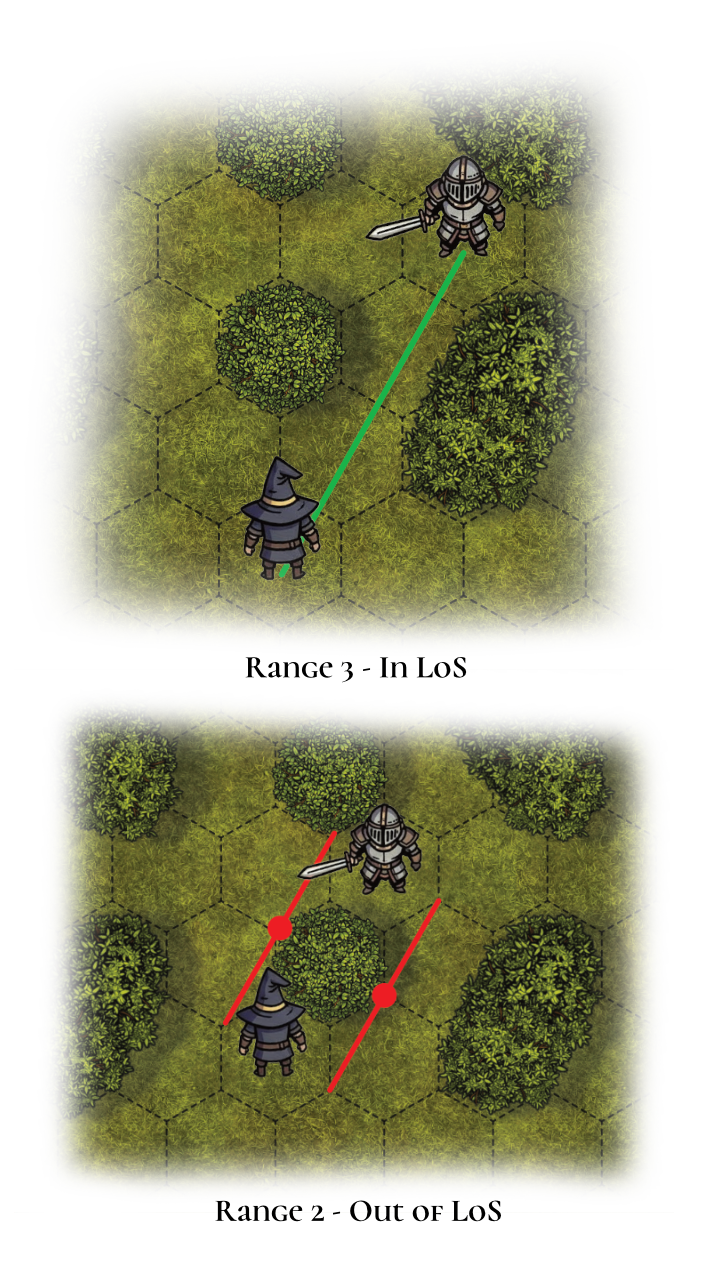
Range N means an action can affect a target up to N spaces away and within the user's Line of Sight (LoS) — both conditions must be met. When an action does not state a Range, it is 1, also called Melee: it affects a unit in an adjacent space (two spaces are adjacent when they share a side).
Line of Sight: if there is a free path between the user's space and the target's space, the two are in each other's LoS. If that path touches a blocked edge, the LoS is blocked. Allied units do not block Line of Sight; enemy units do.
Some actions instead measure distance with wording like "within X spaces". That checks distance only and does not require Line of Sight.
Multi-Use (Keyword)
The action may be used more than once in the same Turn, paying its AP cost each time.
Reaction (Keyword)
An action with this keyword can be activated outside the unit's Turn. When the opponent declares an action, you may announce the Reaction before it resolves. The Reaction is then executed first, and only after it fully resolves does the opponent's action proceed. When multiple Reactions are declared, they are executed from the latest to the oldest.
If the Reaction changes the battlefield in a way that makes the opponent's declared action no longer valid — for example, moving the intended target out of range — that action is cancelled with no effect. Any costs already paid for it are still spent.
Knockback (Keyword)
Knockback N pushes the target unit N spaces in a straight line in the direction chosen by the attacker, directly away from the source of the effect.
- The movement does not use the unit's Movement attribute and does not cost it any AP.
- If the path is blocked (impassable terrain, the edge of the map, or another unit), the unit stops on the last free space.
Focus (Keyword)
Focus is a Status Effect, tracked with a token. It marks that a unit is in a Focus state; its specific rules vary based on the Class that grants or relies on it.
Engage (Keyword)
Engage X means the unit moves up to X spaces toward the nearest hero by the shortest path, stopping as soon as it reaches melee (an adjacent space).
Prey (Keyword)
Prey X means the unit moves up to X spaces toward the Weakest hero — the hero with the most Wounds (closest to defeat). Break ties by nearest, then by the Dark Rule.
Distance (Keyword)
Distance X (a–b) means the unit moves up to X spaces to keep its distance from the nearest hero between a and b spaces: it moves closer if it is too far, and moves away if it is too close. Used by ranged enemies to kite.
Tokens
Tokens are applied to and removed from units to track Wounds and status effects. The current ruleset uses a small set of tokens:
| Icon | Token | Type | Description |
|---|---|---|---|
 |
Wound | Counter | Tracks the damage a unit has taken. When the number of Wound tokens exceeds the unit's Vitality, the unit is defeated. |
 |
Activation | Marker | Marks a unit that has already been activated this cycle. When all of a player's units are marked, all their Activation markers are removed. See Activation. |
 |
Focus | Status Effect | Marks a unit in a Focus state. Its specific rules vary based on the Class. See the Focus keyword. |
 |
Poison | Counter | If a unit ever accumulates 3 Poison tokens, it is immediately defeated, regardless of its Wounds. Whenever an effect heals the unit, it removes that same number of Poison tokens as well. |