Getting Started
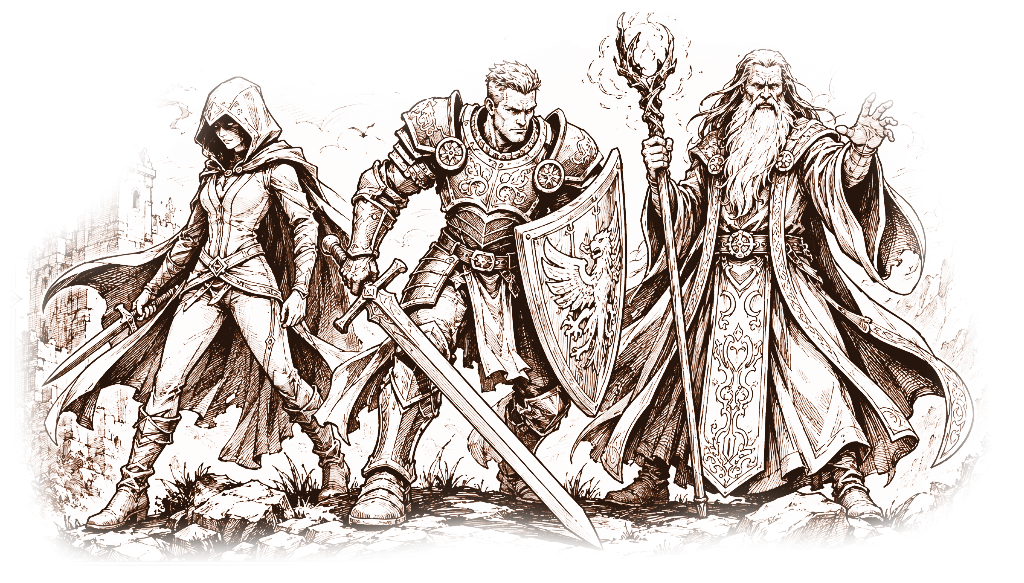
The best way to learn how to play is by playing!
This guide walks you through preparing and playing a Team Battle (3 vs 3) match between two players. Let's go through every step.
Team Builder
To enter a battle you need a team of heroes. In a standard Team Battle each player brings 3 units.
Each unit is simply a Class plus a miniature. Every Class comes with a fixed profile: its attributes, movement, and three Actions.
Choose 3 Classes for your team, for example a Knight, a Mage and an Assassin. Aim for synergy: a frontline unit to control space, a damage dealer, and some support or reach. You can review every Class on the Classes page.
Get Cool Miniatures
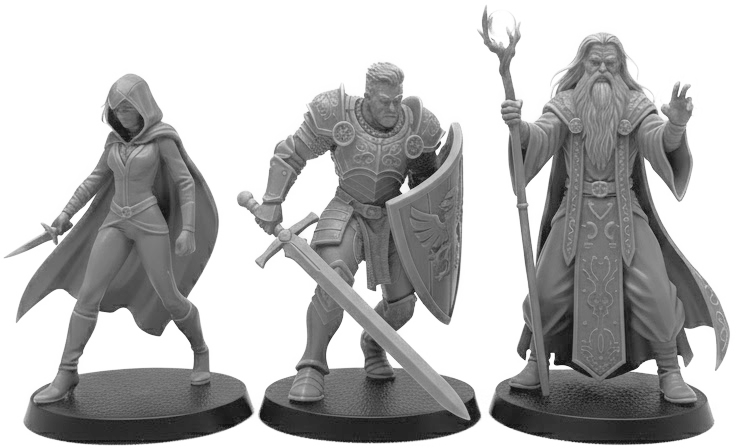
Bring your hero miniatures with the most badass paint job in the world! Anything works, from a paper miniature to a custom resin print. The only rule is that the base should be a standard 1 inch (28 mm) base so it is compatible with the Battle Maps.
Battle Preparation
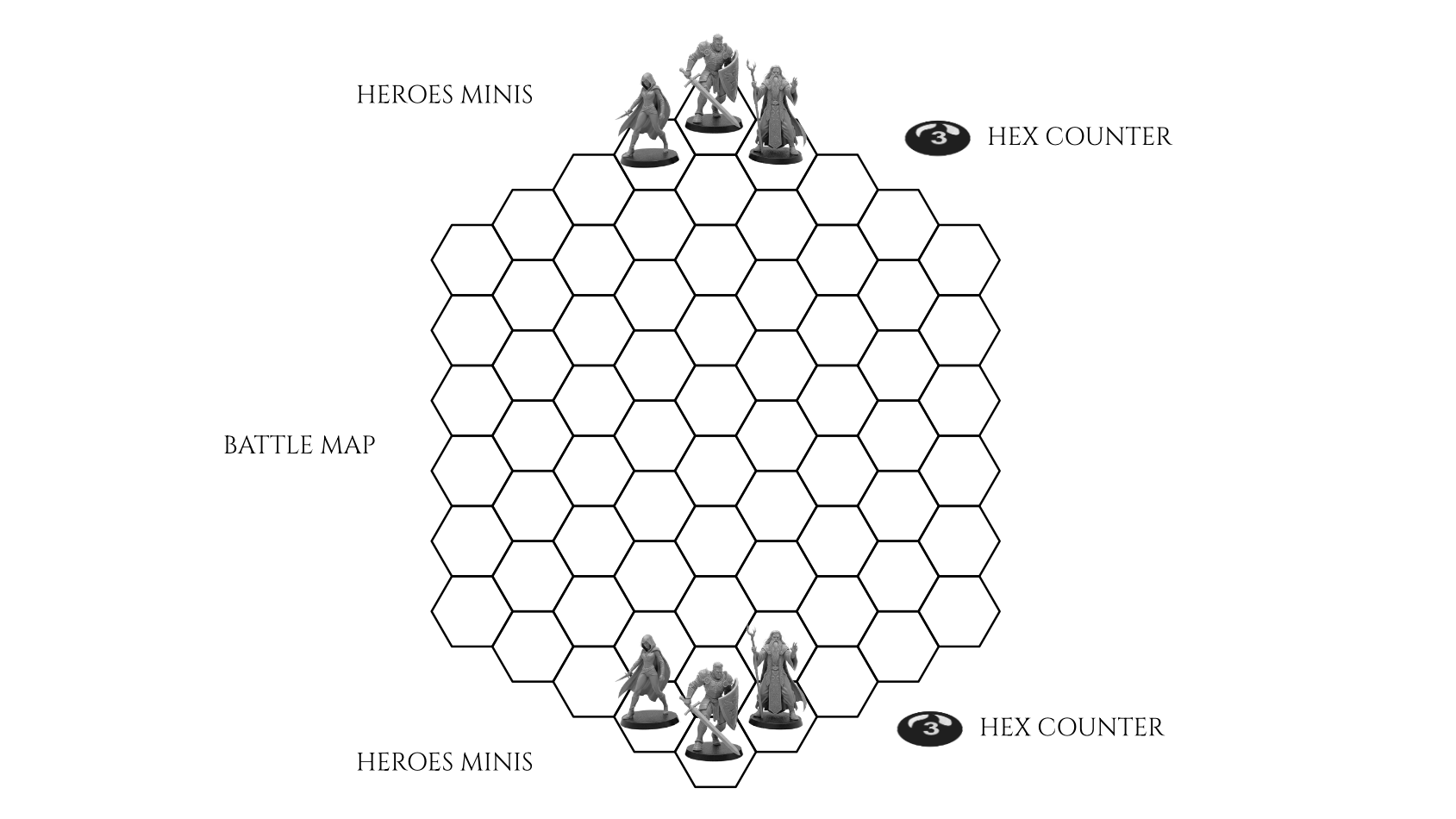
Place the Battle Map of your choice on the table. Each player then gathers their components:
- Several D6 dice.
- Wound tokens, Activation markers and other status tokens.
- A HEX Counter (a D20 or any counter). You start the game with 0 HEX.
- Each player rolls 1D6. The higher result decides who takes the first Turn (reroll on a tie) or you can choose any other way to pick who decides.
Deploying Heroes
- Starting with the first player, each player places one Hero miniature in any available "Initial Position" on the Battle Map. If the map doesn't specify, the first row counts as an Initial Position.
- Players alternate placing miniatures until all 3 heroes of each side are on the board.
- If the scenario requires, add any extra tokens or items informed.
Playing the Game
Heroes of Hex uses a Continuous Activation System: there are no traditional rounds. Players alternate activating a single unit at a time, each picking from their not-yet-activated units, so neither side gains a structural advantage from acting first or from an unbalanced unit count. The player with the initiative takes the first unit Turn, then the initiative passes to the opponent, and so on until the game ends.
You are not required to activate a unit on your Turn; if you prefer, you may simply pass without activating anyone.
A Hero's Turn
Every unit Turn follows four steps:
Step 1: Fate Roll
Roll 1D6. The result (1–6) is the number of Action Points (AP) the unit you are about to activate can spend this Turn.
If you don't like the roll, you may Negate Fate, paying 3 HEX to reroll it once, before spending any AP. The new result is final.
Step 2: Choose the Unit to Activate
Look at your AP and ask yourself: how do I make the most of this? A high roll might fuel a multi-step play; a low roll might be best spent repositioning a unit. Choose one of your units that has not been activated yet this cycle, that is, one without an Activation marker.
You cannot keep sending the same unit into action over and over: once a unit is activated, it takes an Activation marker and is set aside until each of your other units has had its Turn. Only when all your units carry a marker do you remove them all and start fresh, free to pick any unit again. This pushes you to spread the action across your whole team.
Step 3: Unit Turn
Spend the unit's AP on Movement and its Actions, paying each cost as you go. Unused AP are lost at the end of the Turn. Each action can be used once per Turn (unless it has the Multi-Use keyword).
Some actions are paid with HEX instead of AP. These are typically the most powerful effects in a Class's kit.
Step 4: End the Turn
Place an Activation marker next to the unit you activated. You gain 1 HEX, and the initiative passes to your opponent.
Combat Resolution
Attacks and other actions that target enemies are resolved as opposed rolls. The attacker rolls D6 equal to their Attack attribute; the defender rolls D6 equal to the matching Defense. Each keeps only their highest die, and the Combat Result is the attacker's highest minus the defender's highest.
The outcome of the combat is determined by the type of the attack and the resulting margin of the Combat Result. Each attack type has a threshold at which it kills the enemy; if that threshold is not reached, the result counts as a Wound:
| Attack | Death Threshold |
|---|---|
| Light | 4+ |
| Normal | 3+ |
| Heavy | 2+ |
A Wound places a Wound token on the unit; when its Wounds exceed its Vitality it is defeated. A Death result removes the unit instantly. A margin of 0 or less is a miss.
Combat example
The Knight (Attack 2) uses Heroic Strike (a Normal attack) against an enemy with Defense 1. The Knight rolls 2D6 → 3, 5; the defender rolls 1D6 → 2. Combat Result = 5 − 2 = 3. On a Normal attack, a margin of 3+ is a Death: the enemy is removed from the game.
Gathering HEX
You bank 1 HEX every Turn you take. Besides Negate Fate (rerolling your Fate Roll for 3 HEX), HEX pays for certain Class Actions. Actions paid in HEX cannot be used twice in the same Turn, and those with the Reaction keyword can even be used on your opponent's Turn.
Winning the Game
Turns alternate until one player has all their units eliminated, or until a scenario's objective is met.
Next Steps
That's everything you need to play your first match! Some additional material to explore:
- Resources: print-and-play components like miniatures, maps and tokens.
- Classes: every Class, its profile and actions.
- Compendium: detailed rules for every system, keyword and token.
- Solo & Co-op: rules for playing against PvE enemies.